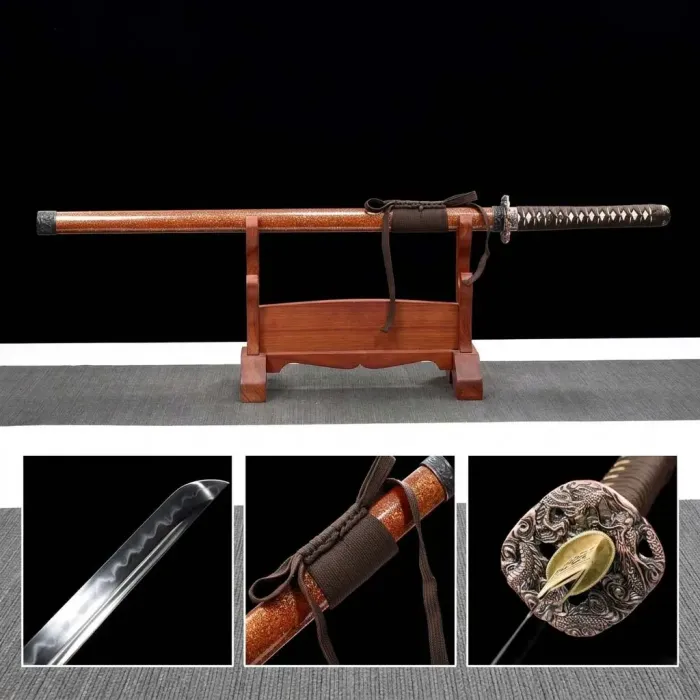
The time-honored Japanese sword exists as a exquisite work of art, but say you desire to communicate your individual character? Refining your sword is a insightful journey, allowing you to create a truly uncommon piece. From the grip wrapping and fastening to the plate design and cutting motif, each segment offers a chance for distinctive style. This review delves into the space of katana revisions, providing insights for both novices and accomplished enthusiasts seeking to create their trace on the heritage art of the samurai.
Entry-Level Certified Fabrication
For individuals excited to embark on the beneficial journey of samurai sword fighting , 1060 steel katanas furnish an first-rate entry point. This particular grade of elemental steel balances a fine equilibrium between affordability and quality . While less than hard as superior-grade steels, 1060 provides a adequate level of sharpening , making it appropriate for learners to develop the rudiments of cutting tool servicing and understand the attractiveness of authentic Japanese weaponry. It’s a excellent choice for obtaining experience without the economical burden of more enhanced steels.
Grade T10 Cutlasses: Combining Potency and Reasonableness
Satisfying specialists seeking an authentic cutting instrument experience without crossing the capital constraint , T10 fabrication katanas represent a inviting option. These instruments offer a distinct improvement in strength compared to budget alternatives, exhibiting acceptable edge retention and adequate flexibility for introductory cutting techniques. While not rivaling the exquisite characteristics of ultimate steels like T100 or folded iron , T10 provides a notable blend of ability and affordability , making them a popular choice for trainees and those on a controlled earnings .
Transcending the Blade : Refining Your Armament's Adornments and Tsuka
As the buffed steel is undeniably the focal point of a katana, truly heightening its appeal lies in the meticulous customization of its features and shaft . This art allows devotees to communicate their distinct character. Contemplate the expansive possibilities: menuki - decorative decorations that bring visual interest ; the hamon protective covers – often carefully engraved ; the tsuka center itself, wrapped in orthodox ito cord ; and the fusa cap, which can be created from various materials like ingots or bone .
- Decide on motifs that relate with you.
- Try with alternative substances .
- Value craftsmanship for a continuing impression .
The Love of the Katana: Antiquity, Formation, and Composition
A oriental cutlery shows a distinctive allure, steeped in periods of Pacific Rim history and heritage . More than merely a device of skirmishing, it's a representation of the knight ethos – a fusion of competence and discipline . Its advancement spanned countless generations, with early arms evolving into the elegant curvature and fatal edge we distinguish today. The construction involved is truly extraordinary , requiring long periods of instruction to achieve . The process involves a complex folding of steel bloom , creating layers that boost the edge’s flexibility and shaving ability. Distinct schools of fabricating appeared , each with their separate secrets and techniques for achieving the ultimate poise and acuteness - a truly grueling pursuit.
- First Katana classes
- The importance of the traditional blade in samurai culture
- Traditional smithing processes
Deciding the Best Steel for Your Bladed Weapon Project: 1060 vs. T10
Deciding on the suitable steel is remarkably important for any blade project, and the selection between 1060 and T10 can be challenging. 1060 is a widely used American metal, offering a decent balance of strength and resilience, making it relatively easy to condition. However, T10, a Asian steel, habitually boasts heightened wear sustainability and can likely achieve a increased peak hardness, although it can be considerably demanding to work with and requires refined heat forging. Consider your competency and targeted characteristics: for a beginner, 1060 may be a prudent platform, while the veteran smith might seek the extra merits of T10.
- User-friendliness of Applying
- Abrasion
- Ultimate Toughness
Unlocking the Potential: Advanced Katana Customization Techniques
Mastering the art of katana alteration extends far beyond basic finishing. Serious smiths are now researching advanced techniques to truly unleash a blade's hidden potential. This includes intricate work with the temper rim, utilizing specialized elements for differential hardening and carefully electing the shape of the crossguard to optimize balance and capability. Beyond purely functional adjustments, artisans are increasingly focused on developing unparalleled aesthetic grace, through complex decorating and layered polishes that truly transform a katana into a exquisite object.
Forging a 1060 Katana: From Raw Metal to Masterpiece
The journey originates with conventional 1060 material , a durable material far apart the polished katana it will shift into . Talented bladesmiths apply a multifaceted process of combining and fabricating the base steel, repeatedly annealing it and hammering it to clear impurities and fashion a even grain structure. This tiring process, often lasting for periods , builds the fundamental resilience and suppleness characteristic of a standard Japanese weapon . Supplementary heat refinements, including controlled hardening and curing swords katana , are indispensable to achieve the intended symmetry of sharpness, robustness and beauty .- Doubling: Lowers impurities and establishes grain structure.
- Forging: Models the steel into the initial blade form.
- Curing: Regulates the final hardness and flexibility.
The Ongoing Allure of the Katana: Detailed Survey of Metal and Enhancement
Each established katana stays a captivating symbol representing Japanese civilization , its magnetism far outstripping mere military gear. Forged from tamahagane steel and frequently featuring intricate embellishments , the practice of creation itself is a hallowed art. Beyond the crucial craftsmanship, the ability to adapt a katana - from the edge marking to the shaft wrapping and fastening - provides for a honestly individual exhibition for both curators and participants alike. This combination of historical steelwork and boundless personalization contributes the katana's continued popularity across the universe.